100 mg / ml oral solution
levetiracetam
What Levetiracetam Actavis Group is and what it is used for
Levetiracetam is a medicine used to treat epilepsy (a medicine used to treat epileptic seizures).
Levetiracetam Actavis Group is used:
- as the sole treatment in adults and adolescents from the age of 16 with newly diagnosed epilepsy to treat a certain type of epilepsy . Epilepsy is a condition in which patients have repeated seizures (seizures). Levetiracetam is used for the form of epilepsy where the seizures initially affect only one side of the brain, but can then spread to larger areas on both sides of the brain ( partial seizures with or without secondary generalization). Your doctor has given you levetiracetam to reduce the number of seizures.
- in addition to other medicines for epilepsy to treat:
- partial seizures with or without generalization in adults, adolescents, children and newborns from one month of age
- myoclonic seizures (short, sudden twitching of any muscle or muscle group) in adults and adolescents from 12 years of age with juvenile myoclonic epilepsy
- primarily generalized tonic-clonic seizures (major seizures, including loss of consciousness) in adults and adolescents from 12 years of age with generalized epilepsy of unknown origin (the type of epilepsy considered hereditary).
What you need to know before you take Levetiracetam Actavis Group
Do not take Levetiracetam Actavis Group
- If you are allergic to levetiracetam, pyrrolidone derivatives or any of the other ingredients of this medicine (listed in section 6).
Warnings and cautions
Talk to your doctor before taking Levetiracetam Actavis Group.
- If you have kidney problems, follow your doctor’s instructions. He / she decides if your dose needs to be adjusted.
- If you notice that growth slows down or that puberty develops in your child unexpectedly, contact your doctor.
- A small number of people who have been treated with antiepileptic drugs , such as levetiracetam, have also had thoughts of harming themselves or committing suicide. If you have any symptoms of depression and / or suicidal ideation, consult your doctor.
- If you or someone in your family has a previous medical history of irregular heartbeat (seen on electrocardiogram , ECG ) or if you have a disease and / or receive treatment that increases the tendency for irregular heartbeat or salt balance disorders.
Tell your doctor or pharmacist if any of the following side effects gets serious or lasts for more than a couple of days:
- Abnormal thoughts, irritability or unusually aggressive reactions, or if you or your family and friends notice significant changes in your mood or behavior.
- Exacerbated epilepsyIn rare cases, your seizures may worsen or occur more often, mainly during the first month after starting treatment or by increasing the dose . See a doctor as soon as possible if you experience any of these new symptoms while taking Levetiracetam Actavis Group.
Children and young people
Levetiracetam Actavis Group should not be used in children and adolescents under 16 years of age alone ( monotherapy ).
Other medicines and Levetiracetam Actavis Group
Tell your doctor or pharmacist if you are taking, have recently taken, or might take any other medicines.
Do not take macrogol (a medicine used as a laxative ) one hour before and one hour after taking levetiracetam as it may reduce its effect.
Pregnancy and breastfeeding
If you are pregnant or breastfeeding, think you may be pregnant, or are planning to have a baby, ask your doctor for advice before using this medicine. Levetiracetam can be used during pregnancy, but only if the doctor, after careful consideration, considers it necessary.
You should not stop your treatment without first discussing this with your doctor. The risk of birth defects in your unborn baby can not be completely ruled out.
Breastfeeding is not recommended during treatment.
Driving and using machines
Levetiracetam Actavis Group may impair your ability to drive or use tools or machines as Levetiracetam Actavis Group may make you drowsy. This is more likely at the beginning of treatment or after a dose increase. You should not drive or use machines until it has been determined that your ability to perform such activities is not affected.
Levetiracetam Actavis Group contains methyl parahydroxybenzoate, propyl parahydroxybenzoate, maltitol, propylene glycol and sodium
Levetiracetam Actavis Group oral solution contains methyl parahydroxybenzoate (E218) and propyl parahydroxybenzoate (E216) which may cause allergic reactions (possibly delayed).
Levetiracetam Actavis Group oral solution also contains maltitol. If you have been told by your doctor that you have an intolerance to some sugars, contact your doctor before taking this medicine.
Levetiracetam Actavis Group oral solution contains propylene glycol (E1520). If your child is younger than 4 weeks, consult a doctor or pharmacist before using the medicine, especially if the child is taking other medicines that contain propylene glycol or alcohol.
This medicine contains less than 1 mmol (23 mg) sodium per ml, ie essentially ‘sodium-free’.
How to take Levetiracetam Actavis Group
Always take this medicine exactly as your doctor or pharmacist has told you. Ask your doctor or pharmacist if you are unsure.
Levetiracetam Actavis Group should be taken twice a day, once in the morning and once in the evening, at approximately the same time each day.
Take the oral solution following your doctor’s prescription.
Alone treatment (from 16 years of age)
Adults (≥18 years) and adolescents from 16 years:
Measure the correct dose using the 10 ml syringe provided in the package for patients aged 4 years and older.
Usual dose: Levetiracetam Actavis Group should be taken twice a day in two equal doses, each dose being between 5 ml (500 mg) and 15 ml (1,500 mg).
When you first start taking Levetiracetam Actavis Group, your doctor will prescribe a lower dose for 2 weeks before you receive the lowest standard dose.
Additional treatment
Dose for adults and adolescents (12 to 17 years):
Measure the correct dose using the 10 ml syringe provided in the package for patients aged 4 years and older.
Usual dose: Levetiracetam Actavis Group should be taken twice a day in two equal doses, each dose being between 5 ml (500 mg) and 15 ml (1,500 mg).
Dosage in children 6 months and older:
Your doctor will prescribe Levetiracetam Actavis Group in the most appropriate form of medicine for your age, weight, and dose.
For children aged 6 months to 4 years, measure the correct dose using the 3 ml syringe provided in the pack.
For children over 4 years of age, measure the correct dose using the 10 ml syringe provided in the pack.
Usual dose: Levetiracetam Actavis Group should be taken twice a day in two equal doses, each dose being between 0.1 ml (10 mg) and 0.3 ml (30 mg) per kilogram bodyweight of the child (see dosing example in the table below).
Dose for children 6 months and older
| Weight | Starting dose: 0.1 ml / kg twice a day | Maximum dose: 0.3 ml / kg twice a day |
| 6 kg | 0.6 ml twice a day | 1.8 ml twice a day |
| 8 kg | 0.8 ml twice a day | 2.4 ml twice a day |
| 10 kg | 1 ml twice a day | 3 ml twice a day |
| 15 kg | 1.5 ml twice a day | 4.5 ml twice a day |
| 20 kg | 2 ml twice a day | 6 ml twice a day |
| 25 kg | 2.5 ml twice a day | 7.5 ml twice a day |
| From 50 kg | 5 ml twice a day | 15 ml twice a day |
Dose for infants (1 month to less than 6 months)
For infants aged 1 month to less than 6 months, measure the correct dose with the 1 ml syringe provided in the pack.
Usual dose: Levetiracetam Actavis Group should be taken twice a day in two equal doses, each dose being between 0.07 ml (7 mg) and 0.21 ml (21 mg) per kilogram bodyweight in the infant (see dosage example in the table below).
Dose for infants (1 month to less than 6 months):
| Weight | Starting dose: 0.07 ml / kg twice a day | Maximum dose: 0.21 ml / kg twice a day |
| 4 kg | 0.3 ml twice a day | 0.85 ml twice a day |
| 5 kg | 0.35 ml twice a day | 1.05 ml twice a day |
| 6 kg | 0.45 ml twice a day | 1.25 ml twice a day |
| 7 kg | 0.5 ml twice a day | 1.5 ml twice a day |
Method of administration:
After measuring the correct dose with a suitable syringe, Levetiracetam Actavis Group can be taken orally solution can be diluted in a glass of water or feeding bottle. You can take Levetiracetam Actavis Group with or without food. Levetiracetam may produce a bitter taste in the mouth.
Instructions for use:
Instructions for use in a 10 ml dosing syringe
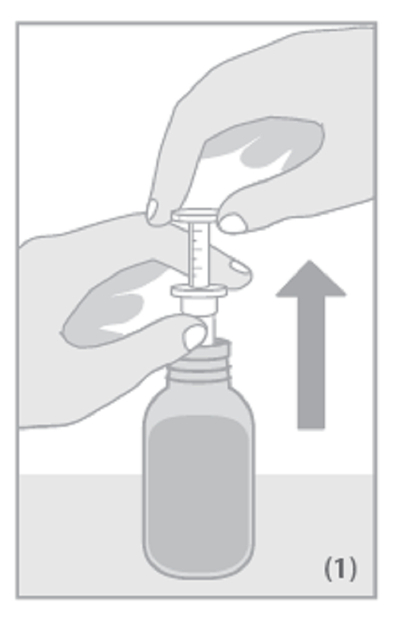
Open the bottle. Before starting the measurement procedure, make sure that the transparent dosing unit on the dosing syringe and the white plunger is in the lowest position. To measure the amount of dosing, use one hand to hold the dosing syringe and the other hand to pull up the plunger until you reach graduation corresponding to the amount in milliliters (ml) prescribed by your doctor (Figure 1).
Pull the syringe with the dosing unit out of the bottle (Figure 2).
Empty the contents of the dosing syringe into a glass of water by pushing the plunger down. Be sure to drink the entire contents of the glass. The contents of the dosing syringe can also be given directly from the dosing syringe into the mouth or emptied on a spoon (Figure 3).
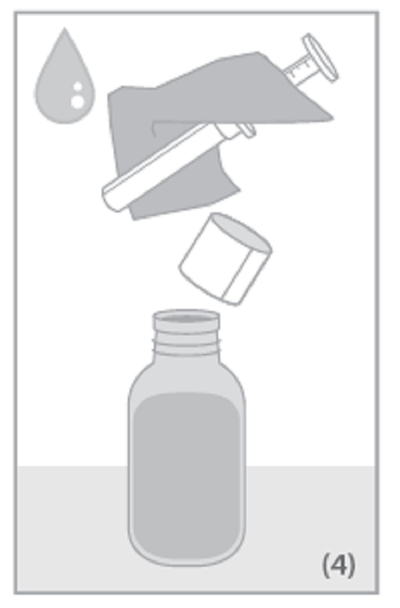
Wash the dosing syringe with water after use and close the bottle with the plastic screw cap (Figure 4).
Instructions for use in 1 ml and 3 ml dosing syringes with an adapter.
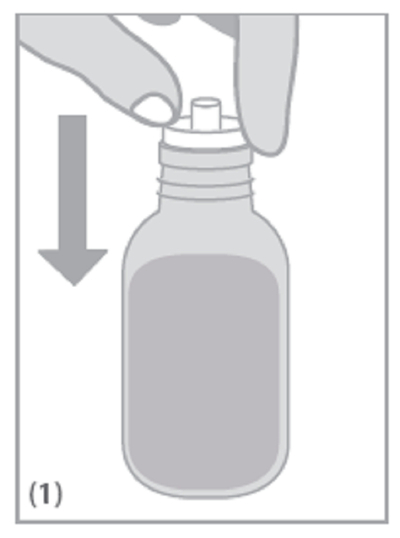
Open the bottle and push the dosing syringe adapter firmly into the neck of the bottle (Figure 1).
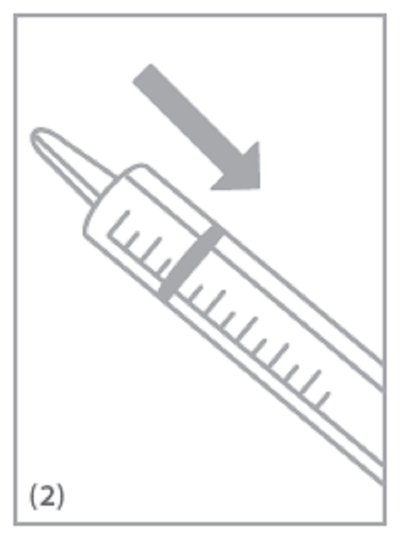
Take the dosing syringe and pull the plunger back a bit (Figure 2).
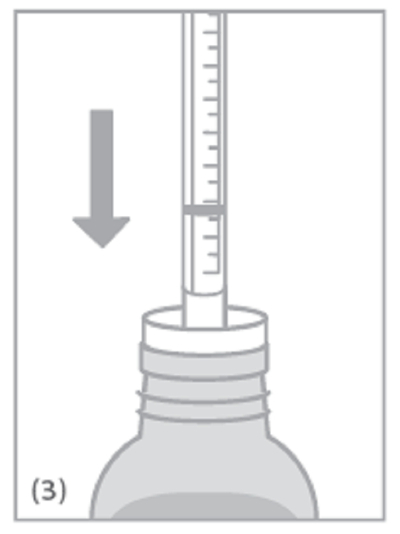
Push the tip of the dosing syringe into the opening of the adapter. Slowly push the plunger in to introduce air into the bottle (Figure 3).
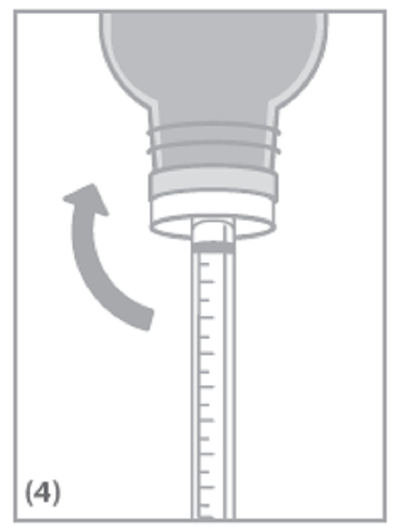
Turn the bottle upside down with the dosing syringe still in place (Figure 4).
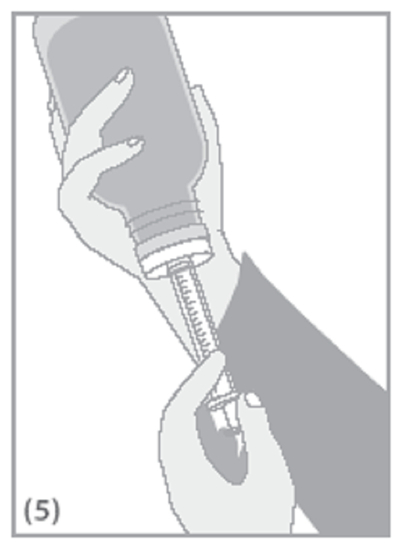
Pull down the plunger and fill the dosing syringe with a quantity of solution slightly outside the prescribed dose (Figure 5).
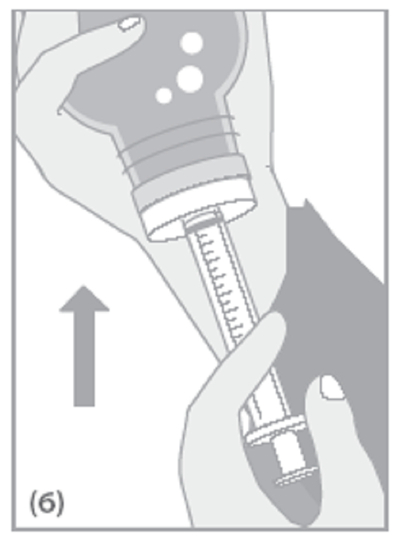
If there are any bubbles in the dosing syringe, hold the bottle upside down and push in the plunger slightly and pull it back again. Repeat until there are no bubbles in the dosing syringe (Figure 6).
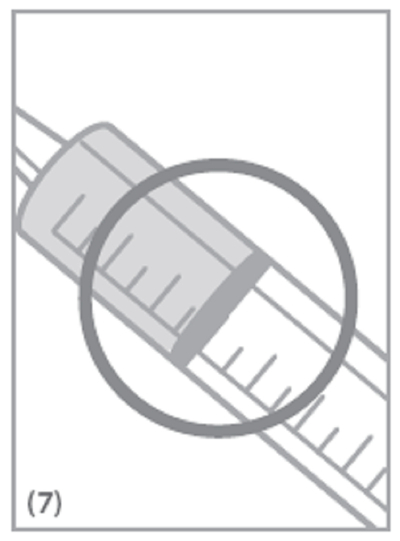
Slowly push the plunger to the mark corresponding to the amount in milliliters (ml) prescribed by your doctor (Figure 7).
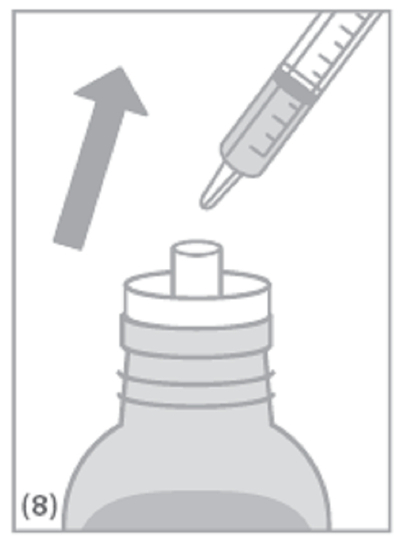
Turn the bottle upside down and remove the dosing syringe (Figure 8).
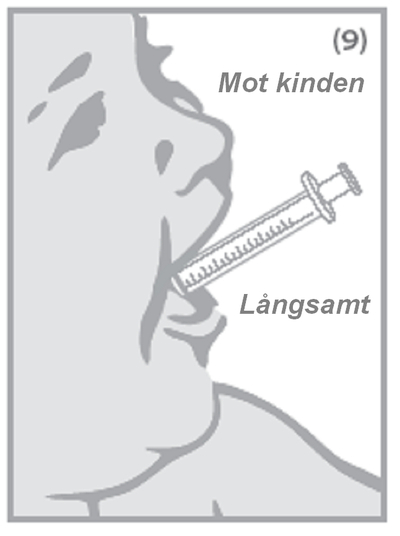
For small children, gently insert the dosing syringe tip into the baby’s mouth on the inside of the cheek. Slowly push in the plunger and allow the child to swallow the contents of the dosing syringe. The contents of the dosing syringe can also be emptied into a glass of water or the feeding bottle. Be sure to drink the entire contents of the glass (Figure 9).
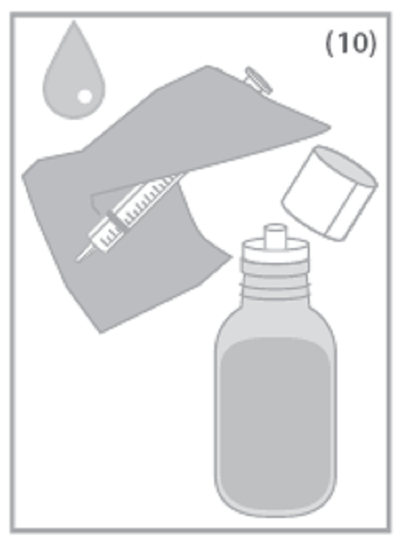
Wash the dosing syringe with water after use and close the bottle with the plastic screw cap (Figure 10).
Processing time:
- Levetiracetam Actavis Group is used as a long-term treatment. You should continue treatment with Levetiracetam Actavis Group for as long as your doctor tells you.
- Do not stop treatment without consulting your doctor, as this may increase the number of seizures.
If you use more Levetiracetam Actavis Group than you should
Possible side effects of an overdose with Levetiracetam Actavis Group are drowsiness, agitation, aggression, decreased alertness, respiratory arrest, and coma .
Contact your doctor if you have taken more Levetiracetam Actavis Group than you should. Your doctor will decide on the best treatment for overdose.
If you forget to take Levetiracetam Actavis Group
Contact your doctor if you have missed one or more doses.
Do not take a double dose to make up for a forgotten dose.
If you stop using Levetiracetam Actavis Group
If treatment with Levetiracetam Actavis Group is to be stopped, this should be done gradually to avoid an increase in seizures. If your doctor decides to stop your treatment with Levetiracetam Actavis Group, he/she will instruct you on how to stop treatment with Levetiracetam Actavis Group gradually.
If you have any further questions on the use of this product, ask your doctor or pharmacist.
Possible side effects
Like all medicines, this medicine can cause side effects, although not everybody gets them.
Talk to your doctor immediately or see your nearest emergency department if you experience:
- weakness, dizziness or feeling dizzy or having difficulty breathing as this may be a sign of a severe allergic (anaphylactic) reaction
- swelling of the face, lips, tongue and throat ( Quincke’s edema )
- flu-like symptoms and rash on the face followed by a widespread rash with fever, elevated levels of liver enzymes seen in blood samples, and an increase in the type of white blood cells ( eosinophilia ) and enlarged lymph nodes (Drug Reaction with Eosinophilia and Systemic Symptoms [DRESS])
- symptoms such as small urine volume, fatigue, nausea, vomiting, confusion and swelling in the legs, ankles or feet, as this may be a sign of sudden renal impairment
- skin rash that can form blisters and look like small targets (central dark spots surrounded by a paler area with a dark ring around the edge) ( erythema multiforme )
- extensive skin rash with blisters and flaky skin, especially around the mouth, nose, eyes and genitals ( Stevens-Johnson syndrome )
- a more severe form of skin rash that causes skin detachment on more than 30% of the body surface ( toxic epidermal necrolysis )
- signs of severe mental changes or if someone around you detects signs of confusion, drowsiness (drowsiness), amnesia (memory loss), impaired memory (forgetfulness), abnormal behavior or other neurological signs including involuntary or uncontrolled movements. These may be symptoms of encephalopathy .
The most commonly reported side effects are inflammation of the nose and/or throat, somnolence (drowsiness), headache, fatigue, and dizziness. At the beginning of treatment or when increasing the dose, side effects such as drowsiness, fatigue, and dizziness may be more common.
However, these side effects should decrease over time.
Very common: may affect more than 1 in 10 people
- inflammation of the nose and / or throat
- somnolence (drowsiness), headache
Common: may affect up to 1 in 10 people
- anorexia (loss of appetite)
- depression, hostility or aggression, anxiety, insomnia, nervousness or irritability
- cramps, balance disorders, dizziness (feeling of instability), drowsiness (lack of energy and enthusiasm), tremor (involuntary shaking)
- vertigo (feeling of rotation)
- cough
- abdominal pain, diarrhea, dyspepsia (stomach upset), vomiting, nausea
- rash
- weakness / fatigue (fatigue)
Uncommon: may affect up to 1 in 100 people
- decreased platelet count , decreased white blood cell count
- weight loss, weight gain
- suicide attempts, suicidal thoughts, mental disorders, abnormal behavior, hallucinations, anger, confusion, panic attacks, emotional lability / mood swings, agitation
- amnesia (memory loss), impaired memory (forgetfulness), abnormal coordination / ataxia (impaired coordination of movements), paresthesia (tingling), disturbance of attention (impaired ability to concentrate)
- diplopia (double vision), blurred vision
- elevated / abnormal values on liver function tests
- hair loss, eczema , itching
- muscle weakness, myalgia (muscle pain)
- damage
Rare: may affect up to 1 in 1,000 people
- infection
- decreased number of all types of blood cell s
- severe allergic reactions (DRESS, anaphylactic reaction [severe and severe allergic reaction ], angioedema [swelling of the face, lips, tongue and throat])
- decreased concentration of sodium in the blood
- suicide, personality disorders (behavioral problems), abnormal thinking (slow thinking, inability to concentrate)
- delirium
- encephalopathy (see section “Talk to your doctor immediately” for a detailed description of the symptoms)
- the attacks may worsen or occur more often
- uncontrollable muscle spasms affecting the head, torso, arms and legs, difficulty controlling movement, hyperkinesia (hyperactivity)
- altered heart rhythm (echocardiogram)
- pancreatitis
- liver failure, hepatitis
- rapidly impaired renal function
- rashes that can form blisters and look like small spots, dark spots surrounded by lighter surfaces, with a black line around the edge ( erythema multiforme ), scattered rashes with blisters and flaky skin, especially around the mouth, nose, eyes and genitals ( Stevens- Johnson syndrome ) and more severe forms that cause skin detachment on more than 30% of the body surface ( toxic epidermal necrolysis )
- rhabdomyolysis (degradation of muscle tissue) associated with elevated creatine phosphokinase in the blood. The incidence is significantly higher in Japanese patients compared to non-Japanese patients.
- lame gait or difficulty walking.
How to store Levetiracetam Actavis Group
Keep out of sight and reach of children.
Do not use this medicine after the expiry date which is stated on the carton and bottle after “EXP”. The expiration date is the last day of the specified month.
Do not use after 7 months from first opening the bottle.
No special storage instructions.
The medicine should not be disposed of via wastewater or household waste. Ask your pharmacist how to dispose of medicines no longer required. These measures will help to protect the environment.
Contents of the pack and other information
Content declaration
The active substance is levetiracetam. Each ml contains 100 mg of levetiracetam.
The other ingredients are sodium citrate, citric acid monohydrate, methyl parahydroxybenzoate (E218), propyl parahydroxybenzoate (E216), ammonium glycyrrhizate, glycerin, glycerol (E422), liquid maltitol (E965), propylene sulfamalkal (propylene sulfamalkal).
What the medicine looks like and contents of the pack
Levetiracetam Actavis Group 100 mg/ml oral solution is a clear, slightly yellow-brown solution.
Levetiracetam Actavis Group 300 ml glass bottle (for children between 4 years and older, adolescents and adults) is packed in a carton containing a 10 ml oral dosing syringe (graded in 0.25 ml increments).
Levetiracetam Actavis Group 300 ml glass bottle (for newborns and young children aged 6 months and up to 4 years) is packaged in a carton containing a 3 ml oral dosing syringe (graded in 0.1 ml increments) and an adapter for the dosing syringe.
Levetiracetam Actavis Group 300 ml glass bottle (for children aged 1 month and younger than 6 months) is packaged in a carton containing a 1 ml oral dosing syringe (graded in 0.05 ml increments) and an adapter for the dosing syringe.
Not all pack sizes may be marketed.
Marketing Authorization Holder and Manufacturer
Marketing Authorisation Holder
Actavis Group PTC EHF.
Reykjavikurvegur 76-78
220 Hafnarfjordur
Iceland
Manufacturer
Balkanpharma Troyan AD
1 Krayrechna Str,
Troyan 5600
Bulgaria
For any information about this medicine, please contact the local representative of the Marketing Authorization Holder:
| Belgium / Belgique / BelgienActavis Group PTC ehf.Iceland / Iceland / IcelandTel: +354 5503300 | LithuaniaUAB Teva BalticsTel: +370 52660203 |
| BulgariaTeva ArmazadTel: +359 24899585 | Luxembourg / LuxemburgActavis Group PTC ehf.IcelandTel: +354 5503300 |
| Czech RepublicTeva Pharmaceuticals CR, sroTel: +420 251007111 | HungaryTeva Gyógyszergyár Zrt.Tel .: +36 12886400 |
| DenmarkTeva Denmark A / STel: +45 44985511 | MaltaTeva Pharmaceuticals IrelandL-IrelandTel: +44 2075407117 |
| GermanyActavis Group PTC ehf.IcelandTel: +354 5503300 | The NetherlandsActavis Group PTC ehf.IcelandTel: +354 5503300 |
| EestiUAB Teva Baltics Eesti subsidiaryTel: +372 6610801 | NorwayTeva Norway ASTel: +47 66775590 |
| GreeceSpecify ABEE:Ηλ: +30 2118805000 | Austriaratiopharm Arzneimittel Vertriebs-GmbHTel: +43 1970070 |
| SpainActavis Group PTC ehf.IcelandTel: +354 5503300 | PolandTeva Pharmaceuticals Polska Sp. Zoo.Tel: +48 223459300 |
| FranceActavis Group PTC ehf.IcelandTel: +354 5503300 | PortugalActavis Group PTC ehf.IcelandTel: +354 5503300 |
| CroatiaPliva Hrvatska dooTel: +385 13720000 | RomaniaTeva Pharmaceuticals SRLTel: +40 212306524 |
| IrelandTeva Pharmaceuticals IrelandTel: +44 2075407117 | SloveniaPliva Ljubljana dooTel: +386 15890390 |
| IcelandTeva Pharma Iceland ehf.Phone: +354 5503300 | Slovak RepublicTEVA Pharmaceuticals Slovakia sroTel: +421 257267911 |
| ItalyActavis Group PTC ehf.IcelandTel: +354 5503300 | Finland / FinlandTeva Finland OyPuh / Tel: +358 201805900 |
| .ΠροςA. Potamitis Medicare Ltd:Ηλ: +357 22583333 | SwedenTeva Sweden ABTel: +46 42121100 |
| LatviaUAB Teva Baltics subsidiary LatvijāTel: +371 67323666 | United Kingdom (Northern Ireland)Teva Pharmaceuticals IrelandIrelandTel: +44 2075407117 |
Information on this medicine is available on the European Medicines Agency website: http://www.ema.europa.eu/.